While I am working on getting back to writing, I’ve been reviewing old stuff on this blog. This article is related to some of my recent studies in church history and bible interpretation. So I thought I’d bring it back up from May 5, 2013 to the top.
Some discussion ensuing from today’s sermon blew my circuits for a moment. The text was Revelation 20:1-6, one of the more controversial bits one encounters in the Scriptures. Of course, we were all talking about the variety of interpretations and how some of them came about. It all ranged from Pre-, A-, and Post- Millennialism, Covenant and Dispensational theology and then, of course, reached back to church history and origins of denominations, etc.
From the Reformed perspective, A and Post-mil perspectives were only recently distinguishable, having been essentially the same camp for a long time (pretty much the last 2k years), and Pre was the aberration that didn’t fit in.
What gets me is how the Premillennial position exploded on the scene. I want to call this a part of the Finney System, or at least a result of it. But I’m probably being too specific in trying to tag a specific person, movement and event. Here’s what’s most at fault:
Think about the 1800s and Finney’s thing. Not so big, right? There have always been crackpots and deviants out there. Finney wasn’t the first and maybe not the worst. What set the stage for mass exposure and sale of the Premillennial position is a combination of elements that still influence us today. Only they were far more efficacious then.
People are so process-system-rules oriented, they will read their system presuppositions into the whole (not just a particular) text. And so, in addition to their individualism (it’s all about me), their need to have a confession (everybody has one), their credulity (downright imbecile acceptance) toward the printed word, their commitment to general consensus (without the same to general criticism) and including the barrage of media as well as a general lack of critical thinking (all of us), we have, instead of Holy Scripture, a guidebook. Instead of a story, declaration, and exposition of theology, a measurable checklist of how things work. Instead of a Christ-centered, Salvation-centered, redemption-centered message, we have a timeline of how everything ties together. As a whole, in our sinful, me-centered condition, we are willing to sacrifice everything to find ourselves in Scripture’s pages. We look carefully for measurables and statistics, orders and steps instead of the Gospel and its transmission.
For comparison, I offer this:
Acts 1, 8 and 10 fulfill the great commission and Revelation 20:1-3. Or, Acts is a manual for building a church and Revelation is a timeline for the last days.
One view holds Acts as descriptive and fulfilling prophecy. Another view holds Acts as prescriptive and indicative of norms for evangelism that reach through the ages.
One of these really points to Christ. The other points to a way for us to identify ourselves specifically in the path of history. One holds Christ’s promise, His covenant and His redemptive work in the focus. The other makes us a textbook that gives us self-assurance and things to do or look for that serve our immediate need for satisfaction. People just believe what they read and hear. We gravitate toward the hoary-heads who pontificate or prate on about anything that sounds deep or meaningful. We gravitate so much that we forget what deep or meaningful mean and end up giving credit and meaningfulness and depth to the most shallow of sentences. Forget Joel Osteen; even kittens and baby hedgehogs have a corner on theology nowadays.
A reader might think I’m all over the map here with this diatribe. I maintain that I’m not. This isn’t fragmented thinking and spewage. This is how we work today. And it’s to our shame.
One relies on Christ. The other relies on rules and timelines.
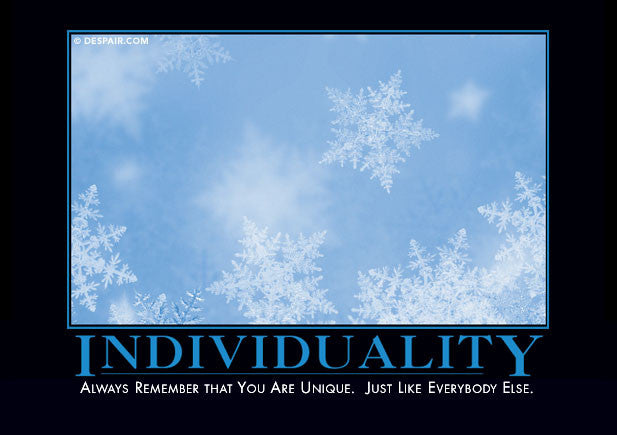
Of course, this extends to groups and epochs, not just YOU.
The rapid expansion of the self-gospel was effected by mass communication in the 19th century, our increasing exposure to group-think and a waning ability to critically consider information on a scale that is far more vast than the Dark Ages experienced. We’re basically in another Dark Ages now, only we’re blinding ourselves and avoiding the elements we need to receive the truth. I mean, instead of the Masters of the Church, it’s we-us-ourselves who are becoming the horse-blinds.
Some Penalties:
- Disassociation from church as the center of our religion and faith. The concept of “Body of Christ” is obscured. This directly leads to devalued means of grace and fellowship. The World is a vampire, sucking our blood.
- Loss of Scriptural integrity. We use the Word as a therapy at best and as an oracle (tarot) at worst.
- Loss of Authority. Any man may interpret so no man may rule. Therefore, we are our own masters. Back to Romans 1.
- Loss of hope. We now depend on a fallible Scripture, riddled with “prophecy” that is only applicable to our present age. When will we ever realize that every age in the last 2,000 years has had its antichrist and there will be plenty more “beast” types coming for us. Maybe we need to look at Scripture with a genuine desire to discover what perspective is best suited to treat it as infallible.
I understand that we still, many times regardless of our theology, assert the same Gospel. Christ lived, died and rose again, paying the penalty for our sins and gaining our forgiveness, righteousness, justification. But our interpretation of His Word counteracts that Gospel when we forget this most precious center of our faith. We become slaves to processes and THE LAW, plans and calendars and false trails of History.
Like someone who is rooted in paranoia, fearing every miniscule event in life because it’s all a personalized twist of the knife, we are unable to hope or trust because there is nothing upon which we may rest.
So there is my “theological progress” for the last year or so. It started out as a small ride along the waves of cultural and historical impact on theology and stuff. And ended up, well, sorta convicting for me.
Have a great week.

 Cold Coffee and Flannel